Saturday, 1 October 2016

Richard Dyer's 'Stardom theory'

Stardom theory- Keith Moon

Keith Moon of The Who is an earlier example of Dyer's Star theory. Though Moon deviated from the typical band star as the drummer of The Who rather than the frontman, his fame reached stardom in the 60s and 70s by meeting many of Dyer's criteria. 

 The Who's success began in the mid-60s and were, as a whole group, known for smashing valuable instruments on stage at the end of sets. Moon however, quickly gained a reputation for being eccentric, funny and very destructive. 

Keith Moon is considered by many sources to be one of the best drummers in rock history: during The Who's rise to fame, Moon was recognised for his unique drumming style, improvised drum fills and lots of crash cymbals. From the offset, Moon started to meet the stardom criteria with his talent and originality.


As the band became more well-known however, Moon started to become recognised for his personality, not just as a band member. He was the joker of the band, often making those who knew him laugh hysterically with his childish behaviour and lack of regard for himself or expensive possessions. 

One famous story about Moon involves his 21st birthday party, which actually took place in America on his 20th birthday, but by publicising the party as his 21st, he would be able to drink. Although none of the event remains as video footage, many celebrities at the time attended the party which took place in a hotel, turning into carnage. Moon started a food fight upon the first guests' arrival and lost half a tooth, on the way to the hospital, the doctors were unable to give him any anaesthetic due to his consumption of amphetamines before removing the rest of his tooth. The damage costed around $24,000, and after that Moon continued to destroy and be banned from all hotels the group stayed in: throwing televisions out of windows, exploding the toilets and in one instance, driving a Lincoln continental into a swimming pool in Rochester. 


During the height of The Who's success, each band member was worth a lot of money, with the earnings of his talent, Moon would spend the money in all sorts of ridiculous manners, mainly paying the bills to the hotel rooms which he would wreck. Comparing his economic background as a child to his wealth and excessive spending as a band member displays the paradox in Richard Dyer's theory, in which a star is simultaneously ordinary and extraordinary.


Keith Moon was also considered to be the most attractive member of The Who, which fits the sexual magnetism of the Stardom criterion, and was youthful throughout the whole of his career and, from his excessive self-destructive behaviour, subsequently died in his youth, at 34 years of age. 
Keith Moon and Pete Townshend of The Who


                                                               Despite his joker exterior and comical acts, it became apparent to those who would spend a lot of time with Moon that he was quickly burning himself out, and that he appeared to be deliberately putting himself in danger. There were also speculations after his overdose in 1978 that Moon committed suicide, taking 32 pills of a medicine that was sufficient to cause death after consumption of 6 tablets, although many of his friends including his bandmates, say that Moon probably died thinking it would be funny for people to find him having overdosed, and perhaps didn't realise that he would not be saved from it. 


Introduction to Stardom theory

Stardom theory

Richard Dyer's star theory is based on the idea that a star is an image, and not a real personality, that is 'manufactured' out of a range of materials. They are said to depend on a range of subsidiary media: such as magazines and radio, to construct an image for themselves. 

Fundamentally, Dyer states, the star image is incoherent, that is incomplete and 'open'. This is because it is based upon two key paradoxes:
Paradox one: The star must be simultaneously ordinary and extraordinary for the consumer
Paradox two: The star must be simultaneously present and absent for the consumer

Dyer argued that as an audience we strive to complete the star image through consuming their products, shows, merchandise etc. We strive to complete the image by engaging with the star’s meta-narrative and, if possible, seek the ultimate satisfaction of seeing them live.


There is criteria for 'stars' to meet, these include:

  • Youthfulness
  • Rebellion
  • Sexual magnetism
  • An anti-authorititarian attitude 
  • Originality
  • Creativity/ talent
  • Aggression/Anger
  • A disregard for social values relating to drugs, sex and polite behaviour
  • Conspicuous consumption of sex, drugs and material goods 
  • Success against the odds

Monday, 19 September 2016

Textual Analysis- Teenage Angst

Teenage Angst- Placebo

For my second textual analysis I have decided to look at Placebo's Teenage Angst. I am interested in the literal and the metaphorical way in which they portray confusion, expression, isolation and alienation among teenagers within the video, and the metaphorical way they communicate teenage angst in general. In my music video, I want to include the extended metaphor of self-fulfilling prophecy, without explicitly stating in the music video that this is occurring. I want my character (a vampire) to be insulted and feared for their existence and consequently, at the end of the music video, kill a person in a vampire-esque way (drinking their blood). 


Mise-en-scene

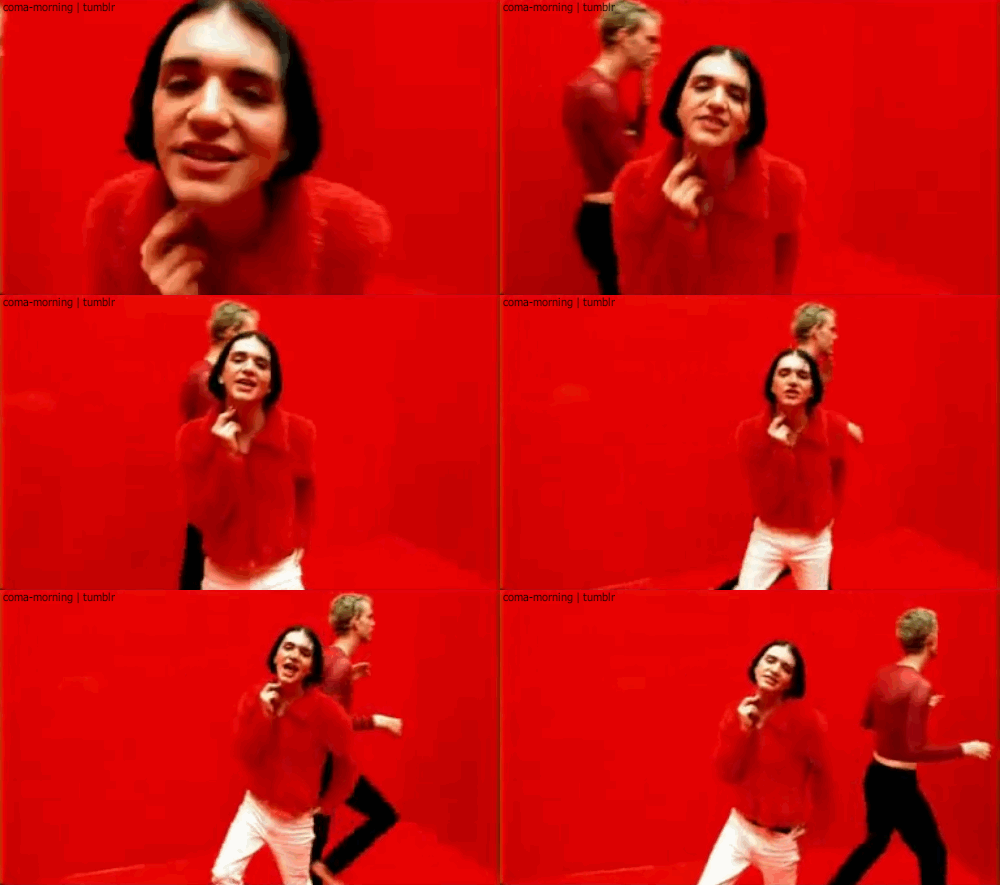
The most apparent element of mise-en-scene within the video is the setting and location. The video appears to take place inside a bright red box in the middle of a sunny field. At the beginning of the video a young boy dressed in what seems to be a white polo shirt (maybe for school) comes across a black box in the middle of a field and enters it. The clothing of the boy could be to indicate his age (as a young school boy) but it could also perhaps stipulate purity or perhaps even naivety.

The fact that the box is in the middle of a scenic field on a sunny day could be stipulating isolation and mental contrast. A child leaves the serene and bright world around him to enter a confined space that he cannot then get out of.

In the extended metaphor that is teenage angst, this entering the box represents the boy entering teenage-hood. The box symbolises the isolation that many teenagers feel whilst growing up.

The colour red is also another prominent aspect of the music video. The colour clearly signifies the title of the song, with the colour red often being associated with anguish, confusion, vexation and desire.

Image result for teenage angst placebo screen grabs
Inside the box, the band members (also the only apparent adults) are shown to be dressed in red, whereas all of the teenagers in the box are wearing white, but are surrounded by red. This could show how the confusion and anxiety you begin to feel about the world when growing up makes a lasting impression on you and may even follow you into adulthood. Goodwin's music video theory also applies here, as there is a link between the song's meaning and the visuals (which metaphorically convey teenage angst through colour) and more specifically, there's a link between lyrics and visuals when the frontman sings "I'm still not satisfied": he and the rest of the band are inside the box for the duration of the video, and appear to be trying to get out just like all of the teenagers.

Editing

Aspects of Goodwin's music video theory is shown through the editing of Teenage Angst, for example, the visuals match the pace of the music when the first two cymbals sound on the intro to the song, where there's a cut to the frontman tilting his head from one side to another. This is also the first time we see the band members and become aware that the music video is a performance/conceptual piece, and so the editing also works to introduce the band into the song.

A match-cut is deployed where the boy tries to escape the red box and a cut away shows him pushing his face into the wall only to find that it stretches, the shot that follows the boy pushing his face forward is the frontman stepping backwards away from the camera, as if finishing the action that the boy had started. 


Tuesday, 6 September 2016

Preliminary CD covers

Preliminary CD covers 
These are the completed CD covers for our preliminary music video/ music video recreation. We were inspired by the original Blur music video when making the CD covers, and used photos taking during the filming shoot. 

After filming our remake of the Popscene music video we took various photos which we intended to be our CD booklet images. As the 'frontman' of the preliminary music video we made, I liked the idea of the photos not showing the face of the singer, and so I was trying to hide my face with my hair during the photoshoot. 

The colour grading of the images were deliberately done to try and replicate the darkness of the music video and the colours used in that. The images are dark and have blue undertones. Our music video has dark tones but more warm orange undertones, which are akin to the original music video which we replicated.

Thursday, 21 July 2016

One minute recreation


This is our completed recreation of 'Popscene' by Blur. It It took 2 hours to film and around 8 hours to edit altogether. It also has a colour effect over the top of the whole video in order to 

Thursday, 14 July 2016

Filming Popscene

Today my fellow worker and I filmed our Popscene recreation. Our filming location was the school hall, and in order to make it seem as though it was not in a school hall, we tacked many black sheets of paper side-by-side to make a background. We brought our own instruments and booked out the hall to use at a time when we could get the footage we needed without interruptions- which happened to be after school until closing time.


Tuesday, 12 July 2016

CD cover ideas

CD Cover

Along with our one-minute music video task, we have also been set the task of designing a CD cover for our 'single'. For this task, I have been trying to analyse the lyrics to 'Popscene' and from there, try and visualise a CD cover that would be appropriate to the song's content. Blur itself is a band who, at the time of Popscene's release, were primarily releasing singles that fit with the 'baggy' and 'britpop' scene, along with bands such as The Stone Roses and Happy Mondays. Initially, the reception of Popscene was not successful, as it was a single that fit more within the genre of punk and grunge, for which, the band Nirvana took the main spotlight at the time. The song allegedly illustrates frontman Damon Albarn's distate for the music business, believing that there are 'too many indie bands'.  The lyrics are as follows:


Popscene
A fervored image of another world
Is nothing in particular now
An imitation comes naturally
But I never really stop to think how
And everyone is a clever clone
A chrome colored clone am I
So in the absence of a way of life
Just repeat this again and again and again
Hey, hey, come out tonight
Hey, hey, come out tonight, popscene, all right
I'm leaving town to run away
Run into your twisted arms
No queues and there's no panic there
Just dangling your feet in the grass
My lack of natural luster now
Seems to be losing me friends
So in the absence of a way of life
Just repeat this again and again and again
Hey, hey, come out tonight
Hey, hey, come out tonight, popscene.